





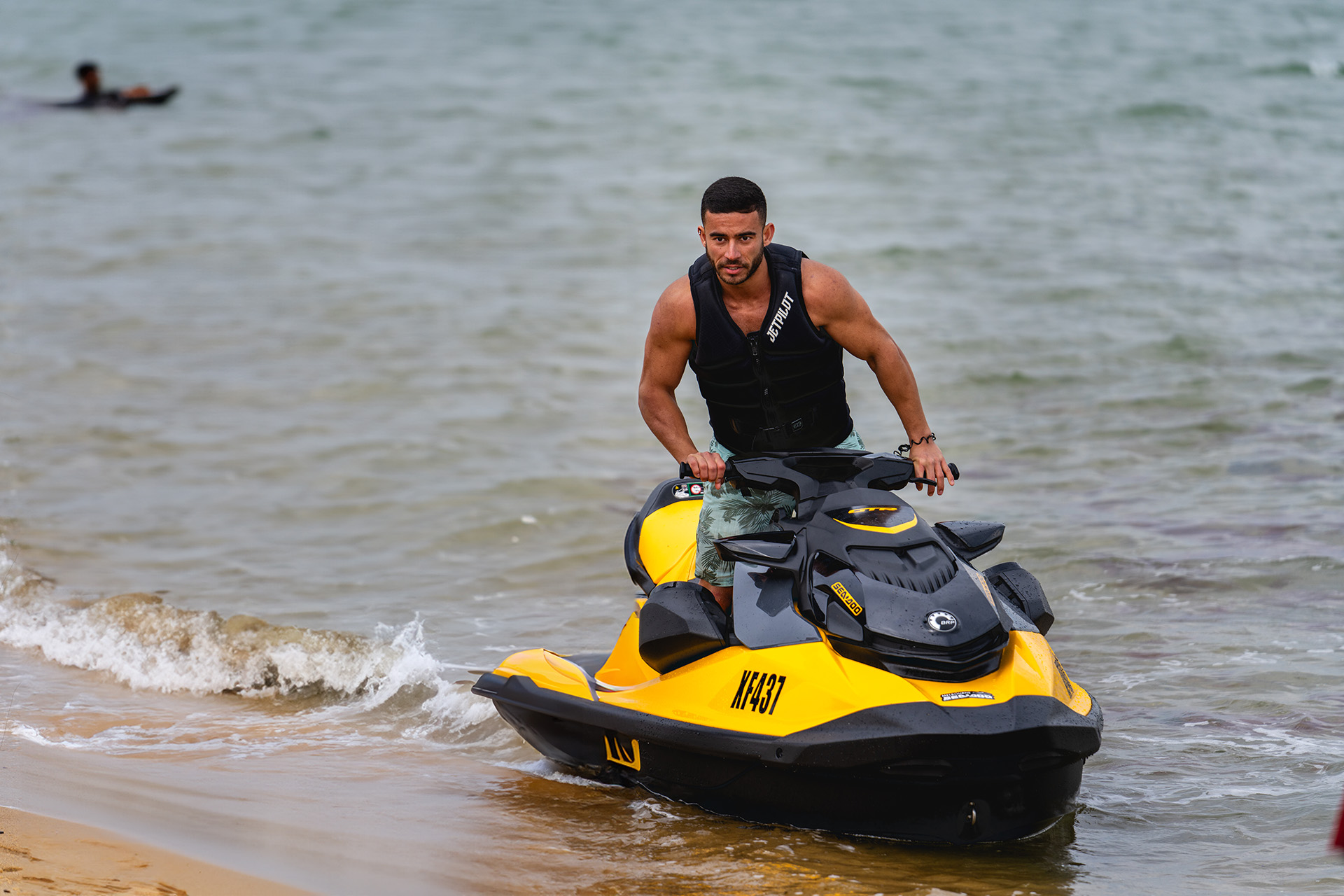
Always put safety first when riding personal watercraft. Follow the rules, carry the right safety equipment and be considerate of others on the water.
Required equipment
Lifejacket
Each person on board or being towed must have an approved lifejacket. Ensure they meet the specified level requirements. ST Vic recommends level 50/50S lifejackets.
Torch
PWCs must carry a working, waterproof and buoyant torch at all times. A torch can be used to signal the shore or other vessels in emergency situations.
Marine licence
Personal watercraft riders must carry their marine licence with PWC endorsement on them when using a jet ski registered in Victoria. Marine licenses including those with PWC endorsement are valid for five years. If you’re under 16, you can’t get a PWC endorsement on your restricted license.
Other useful equipment
Protective clothing
Wearing protective clothing can prevent serious internal injuries. Don’t take the risk, make sure you and your passengers wear neoprene pants every time you ride.
Phone
In a waterproof phone case.
PLB (Personal Locator Beacon)
A PLB is an additional safety measure that can be invaluable in case of an emergency.
Very high frequency (VHF) radio
A VHF radio can be a valuable tool for communication in areas with VHF coverage.
Registered emergency position indicating radio beacon (EPIRB)
If your journey takes you more than 2 nautical miles from the coast (coastal offshore), it’s mandatory to have a registered Emergency Position Indicating Radio Beacon (EPIRB) on board.
Dry bag
Keep your phone and your belongings dry with a waterproof bag.
Navigational lights
PWCs must comply with navigational light marine safety requirements. PWCs operating after sunset or before sunrise must display a red port light, a green starboard light and all-round white lights that are visible from all angles. White lights should remain visible from every angle whether the rider is standing or seated.
Speed and Distance Rules
A 5-knot speed limit applies to personal watercraft (jet ski) riders who are:
- within 200m of the water’s edge on enclosed and coastal waters
- within 500m of the water’s edge between Martha Point to Point Nepean
- within 50m of a person
- within 50m of another vessel (including other jet ski riders)
- within 100m of a vessel or buoy on which a diver below signal corresponding to the International Code Flag A is displayed – a white/blue flag
- within 50m of any wharf, jetty, slipway, diving platform or boat ramp, except in an access lane
- passing through a recognised anchorage for small vessels.
Note: There might be local rules that are different to the state rules of 200m on enclosed waters.
Regulations and Hoon Laws
The International Regulations for Preventing Collisions at Sea apply to all vessel operators, including jet ski riders.
Certain areas are designated as vessel prohibited zones for safety and environmental reasons. It’s crucial to respect these restrictions to protect both the environment and other waterway users.
Learn more about this here.
Similar to when driving, understanding and adhering to give way rules is essential for safe and smooth navigation on the water. Familiarize yourself with the give way rules to avoid collisions and maintain a safe boating environment.
Learn more about this here.
PWCs must display the vessel registration marker on each side of the hull and forward of the beam.
Marker characters should be no less than 100mm high and coloured in contrast to the surface on which they are displayed.
A person must not operate a recreational vessel at a speed or in a manner that is dangerous to the public or wildlife.
Victoria Police can seize a recreational vessel if they suspect it has been used to commit an offence.
Victoria Police and Safe Transport Victoria can stop a vessel’s use with an embargo notice for up to 48 hours for reasons such as a vehicle defect notice.
Victoria Police and Safe Transport Victoria can order individuals off the water for up to 24 hours.
Noise can be a problem with especially near homes and popular areas. To avoid disturbing others, stay away from the shore especially early in the morning or when winds blow onshore.
Towed PWC sports must have an observer on the PWC in addition to the PWC operator and the person being towed.
Licensing and registration


Register your jet ski
